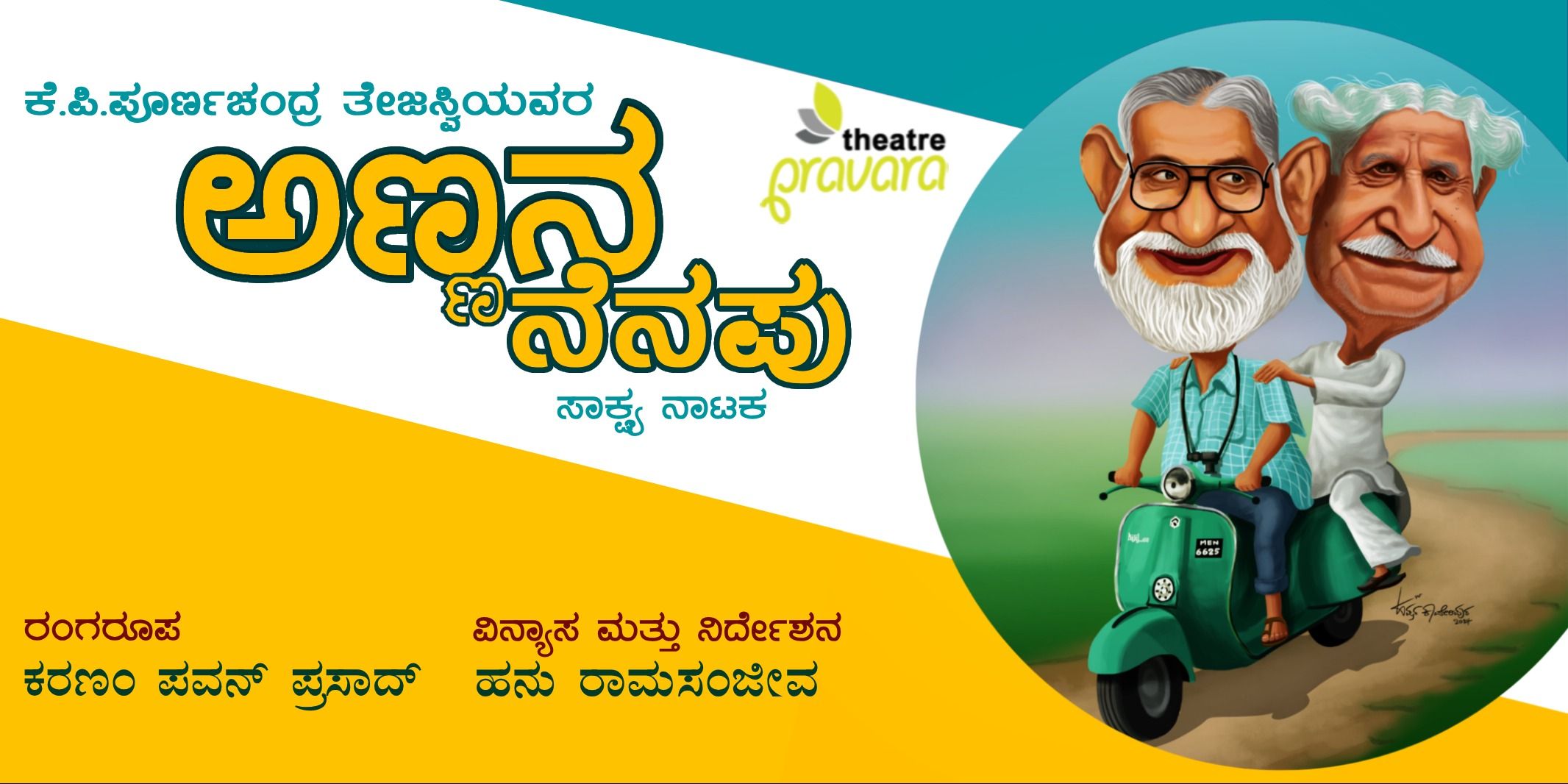



About The Event
"Annana Nenapu" (Docu-Play), presented by Pravara Theatre, is a critically acclaimed stage production adapted from the renowned work by K. P. Poornachandra Tejaswi, and has been performed across several parts of the state, receiving widespread appreciation from audiences and commendation from literary scholars and critics.
Written by K. P. Poornachandra Tejaswi, Annana Nenapu brings alive significant chapters from the life of Kuvempu, Karnataka's revered Rashtrakavi. In one sense, the work traces Kuvempu's life as experienced and observed by Tejaswi; in another, it unfolds as a deeply personal autobiographical reflection. Given Kuvempu's monumental contribution to Kannada cultural history, these memories also stand as vital chapters in the broader narrative of Karnataka's literary and cultural evolution. First published in 1996, Annana Nenapu is a collection of intimate reminiscences centered on Tejaswi's father. In this rare and remarkable work, Tejaswi portrays Kuvempu not merely as a towering literary icon, but as a father and as a profoundly human individual.
Blending gentle humor with insight, each chapter reveals different facets of Kuvempu's personality. Though the son of an extraordinary literary legend, Tejaswi stepped beyond his father's towering shadow to establish his own distinct voice in Kannada literature through his unique style and diverse writings. Whether Annana Nenapu is an autobiography, a son's remembrance, or a reflection on Kannada cultural history remains an engaging question, yet it is, in truth, a seamless blend of all three. The narrative transports readers vividly into that era.
Rather than indulging in glorification, Tejaswi presents Kuvempu's authentic personality through the lens of an ordinary son, capturing his humanity, innocence, scientific temper, and uncompromising integrity through compelling anecdotes. The early chapters brim with humor drawn from childhood and youth, while later sections adopt a more serious tone as they explore the literary currents of the time, including the tensions between the Navya and Navodaya movements.
The work stands as a finely crafted artistic creation, almost novelistic in its richness. The portrait of Kuvempu and the many personalities surrounding him together form a distinctive and invaluable record in Kannada literature.


