

About The Event
ACT Season 16
(February 22-28, 2026)
Various Venues in Delhi/NCR
The 16th edition of ACT – Atelier Campus Theatre Festival marks not just another year of performances but a reaffirmation of what theatre truly stands for: community, collaboration, and collective expression. ACT embraces the spirit of celebration—a celebration of voices, dissent, identities, stories, and the transformative power of coming together.
Atelier’s ACT Festival aka "Atelier’s Campus Theatre" Festival is the World’s Largest Campus Theatre fiesta. Started in 2007, this festival has witnessed more than 800 performances in the last 15 seasons.
In Season 16, we aim to achieve a bigger, better and diverse this year, from February 22-28, 2026.
Festival Curator
Kuljeet Singh
Festival Director
Mansi Grover
Festival Manager
Manjot Singh
Festival Advisor
Gaurav Suri
Name of the group: Masque
Name of the college : Hindu College
Synopsis of the play:
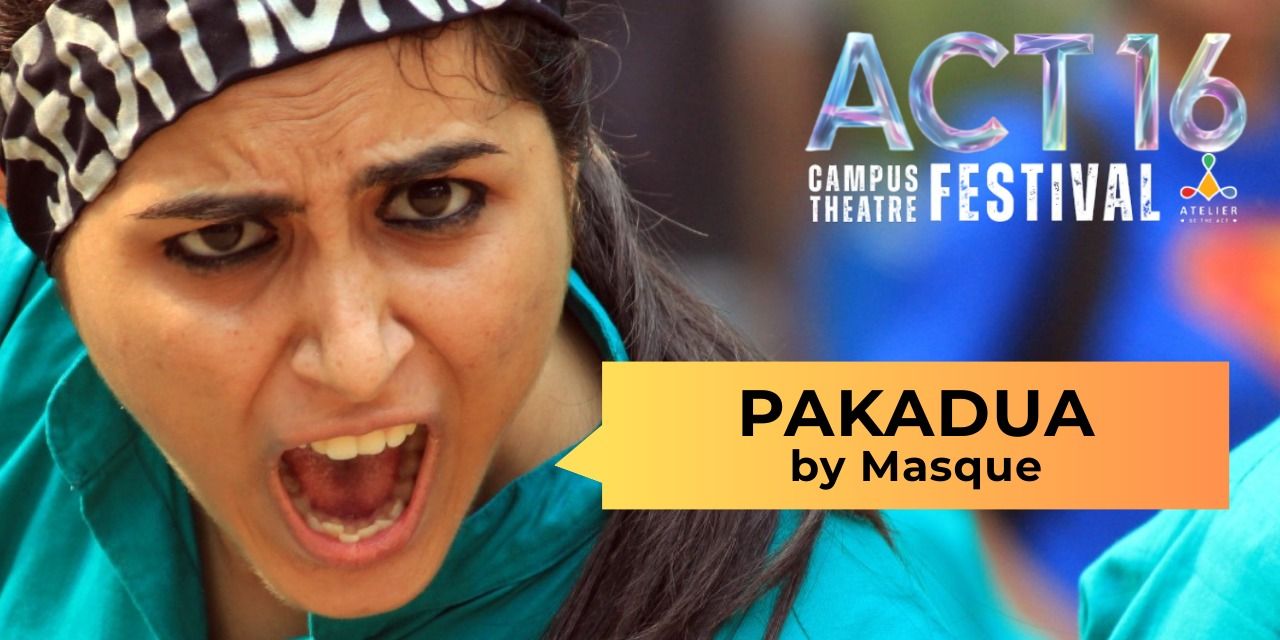
Two childhood friends grow up in the same village, perceiving how the world around them is gradually being emptied. Neighbors relocate to cities, ties break up, and familiar faces become memories that are hard to recall. Scared that they will become strangers to each other also, both boys make a naive but sincere promise-to bind their friendship into something unbreakable. Someday, they say, their children will marry. Blood may drift, but relations will remain. Years have passed. One friend leaves the village. Education, money, urban life reshape him. He rises socially, economically, culturally. The other stays back, builds a respectable life in the village, rooted, dignified, faithful to memory. For him, promises are not metaphors; they are inheritances. Time fulfills the prophecy in form, rather than in spirit. One has a son, the other a daughter. Remembering the vow, the girl`s father approaches his old friend-not out of greed, but out of trust. He speaks to him of childhood, of shared dreams, of a promise spoken under the same sky. But the man he meets is no longer the boy he knew. The city has not merely changed his address; it has rearranged his values. What was once friendship now feels, to him, like contamination. He is disgusted, rejecting the proposal—ridiculing the village, the girl’s inability to read and write, and the audacity of a “backward” man even imagining equality with him. The insult is not private; it is social, public, crushing. Something breaks. Humiliation curdles into resolve. The forsaken friend seeks not reconciliation, he seeks evenness. In a world where power too often comes cloaked in the robes of tradition, he finds an answer that is violent, illegal, yet scarily normalized. The son gets kidnapped, and afterward forced marriage. A Pakdua Vivah .The entire play takes place within a courtroom where law demands facts, whereas the truth refuses to be simplified. Revenge or justice? Crime or consequence? Victim-son, daughter, broken promise, or the long-dead friendship before marriage? Set against the socio-political reality of Bihar and parts of Uttar Pradesh, this play interrogates how class mobility fractures morality, how power rewrites memory, and how tradition becomes a weapon when dignity is denied. Fundamentally, this is not a story only about Pakdua vivah it`s about what happens when friendship meets hierarchy. and when promise collides with privilege.
Trigger warning: Elements of homicide.


