

About The Event
Step into the historic landscape surrounding Humayun Tomb, where monumental architecture, royal burials, gardens, and forgotten structures come together to tell the story of early Mughal Delhi.
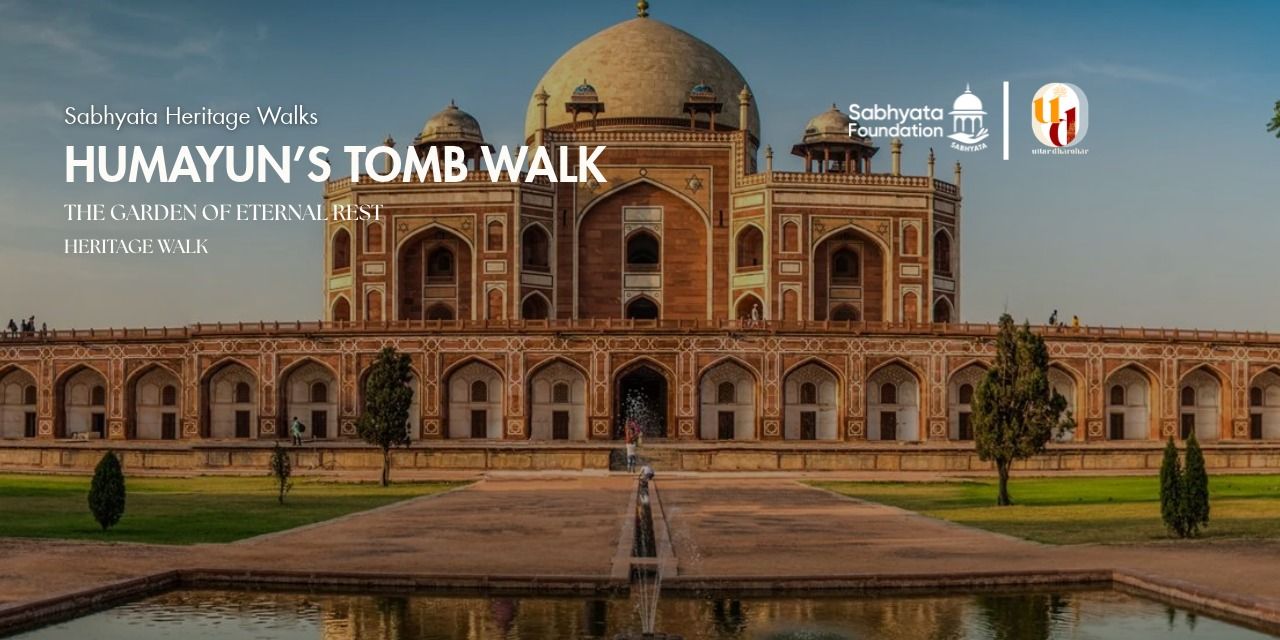
This curated heritage walk by Uttar Dharohar goes beyond the iconic mausoleum to explore the architectural and historical landscape that surrounds it. At the heart of the complex stands Humayun Tomb, set within a carefully planned Charbagh garden of intersecting pathways, water channels, and quadrants. Its monumental arches, octagonal chambers, perforated screens, marble double dome, and red sandstone construction reveal an important stage in the evolution of Mughal architecture.
The walk then takes us through the lesser known monuments that form this historic funerary landscape, revealing how the area developed as a royal and burial zone over several generations. We explore Barber Tomb, the mysterious Nila Gumbad or Blue Dome, and the remains associated with Chilla Nizamuddin Auliya. The journey continues towards Arab Sarai, traditionally associated with Bega Begam and the people involved in the construction of Humayun Tomb, followed by Afsarwala Mosque and Tomb, Bu Halima Garden, Isa Khan Tomb, and Bara Batashewala Mahal offering a fascinating comparison of tombs, gardens, mosques, and decorative architectural traditions.
Join us to uncover the legends etched into these red sandstone walls. Please note that the fee is not for access to the site, but rather for the curation of this experience.
Key theme and Highlights:
1. Explore the Blueprint of the Taj Mahal: Discover the striking architectural similarities and the evolution of the grand doublendome design that inspired India most famous monument.
2. Wander the Persian Style Charbagh: Experience the tranquility of the first garden tomb in India, a perfectly symmetrical four quadrant paradise designed to reflect celestial harmony.
3. Uncover 16th Century Mughal History: Delve into the fascinating legacy of Emperor Humayun and the fusion of Persian and Indian craftsmanship that birthed a new era of imperial architecture
Detailed Itinerary and Flow of the walk:
The walk takes you beyond the familiar image of the monument to explore the ideas, people, architecture, and stories that shaped this extraordinary complex.
What We Explore:
Humayun Tomb and the Charbagh Garden
Understand the concept of the four part garden and its association with the Islamic idea of paradise. Discover how water channels, pathways, geometry, and symmetry were carefully integrated into the landscape.
The Mughal Royal Necropolis
Discover the many rulers and members of the Mughal family associated with the tomb.
Barber Tomb
Explore the identity and history of this intriguing double domed monument.
Nila Gumbad
Uncover the story behind the striking blue tiled dome.
Arab Sarai
examine the history and contested interpretation of this important enclosure.
Afsarwala Mosque and Tomb
study its relationship between mosque and tomb architecture.
Bu Halima Garden
Understand the relationship between gardens and funerary architecture.
Isa Khan Tomb
Encounter an earlier architectural tradition that provides an important contrast to Humayun Tomb.
Bara and Chhota Batashewala Mahal discover lessereknown monuments and their architectural details.
Sabz Burj and Nili Chhatri
explore the wider architectural landscape around Humayun Tomb.
Important Information:
1) Please carry a valid photo ID and your confirmed e ticket for entry.
2) Kindly arrive 30 minutes before the scheduled start time of the heritage walk.
3) Monument entry tickets are not included in the heritage walk fee and must be purchased separately by participants either via ASI website or at the ticket counter.
4) The registration fee covers only the heritage walk (guided tour).
5) Outside food and beverages are not permitted within the monument premises.
6) Tickets are non refundable and non transferable, except in the event of cancellation by the organizer.


