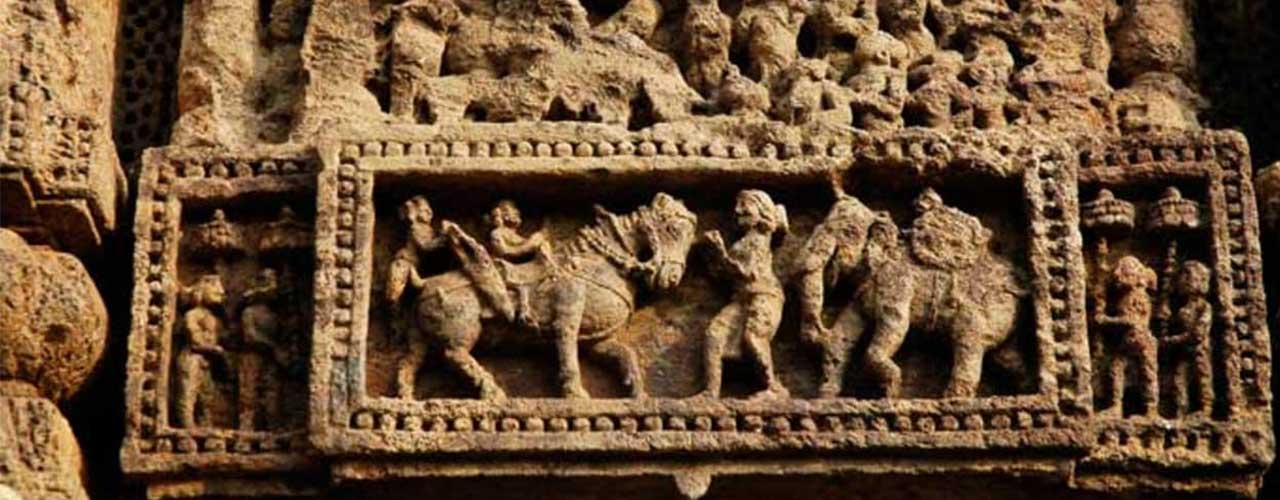
Konark, also known as Arka-kshetra or Padma-kshetra, owes its singular distinction the Sun temple located here. Built-in the thirteenth century A.D by the king Narasimhadeva-I (1238-64 A.D.) of the Ganga dynasty, the patron deity of the temple was Sun or Arka. The temple marks the culmination of art and architecture of medieval Odisha. The temple resembles a colossal chariot with 12 pairs of wheels lavishly sculpted with symbolic motifs and is pulled away by seven spirited horses. The temple comprised of a sanctum with a lofty sikhara (now lost), a Jagamohana or mandapa, 38m high and a detached nata-manadapa in the same axis, all enclosed in a compound wall subsidiary shrines. The sanctum and the nata-mandapa have lost their roof, the Jagamohana alone having preserved its roof intact. The sanctum displays superb images of the Su god in the three projections, while the roof tiers of the Jagamohana harbor colossal figures of female musicians. Several other subsidiary structures are also found within the enclosed area of the rectangular prakara. Among them, the Mayadevi and Vaishnava brick temples are worth mentioning.
OUTSTANDING UNIVERSAL VALUE: The Sun Temple at Konârak, located on the eastern shores of the Indian subcontinent, is one of the outstanding examples of temple architecture and art as revealed in its conception, scale and proportion, and in the sublime narrative strength of its sculptural embellishment. It is an outstanding testimony to the 13th-century kingdom of Orissa and a monumental example of the personification of divinity, thus forming an invaluable link in the history of the diffusion of the cult of Surya, the Sun God. In this sense, it is directly and materially linked to Brahmanism and tantric belief systems. The Sun Temple is the culmination of Kalingan temple architecture, with all its defining elements in complete and perfect form. A masterpiece of creative genius in both conception and realisation, the temple represents a chariot of the Sun God, with twelve pairs of wheels drawn by seven horses evoking its movement across the heavens. It is embellished with sophisticated and refined iconographical depictions of contemporary life and activities. On the north and south sides are 24 carved wheels, each about 3 m in diameter, as well as symbolic motifs referring to the cycle of the seasons and the months.
- Nearest Airport: Biju Patnaik International Airport, Bhubaneswar
- Nearest Railway Station: Puri Railway Station
- Nearest Bus Station: Konark Bus Station
- Opening Hours: Sunrise To Sunset
- Facilities available at monument: Signages, Drinking Water Facility, Toilets for Ladies & Gentleman, Electricity, Publication counter, Brochure/guide book, Illumination of monument, Visitor circulation path, Parking, Ticket booth, Drainage, Garbage bins, Lightening conductor, Wheel chair, Site Museum/display shed any Museum attached with the Monument: Archaeological Museum, Konark.