

About The Event
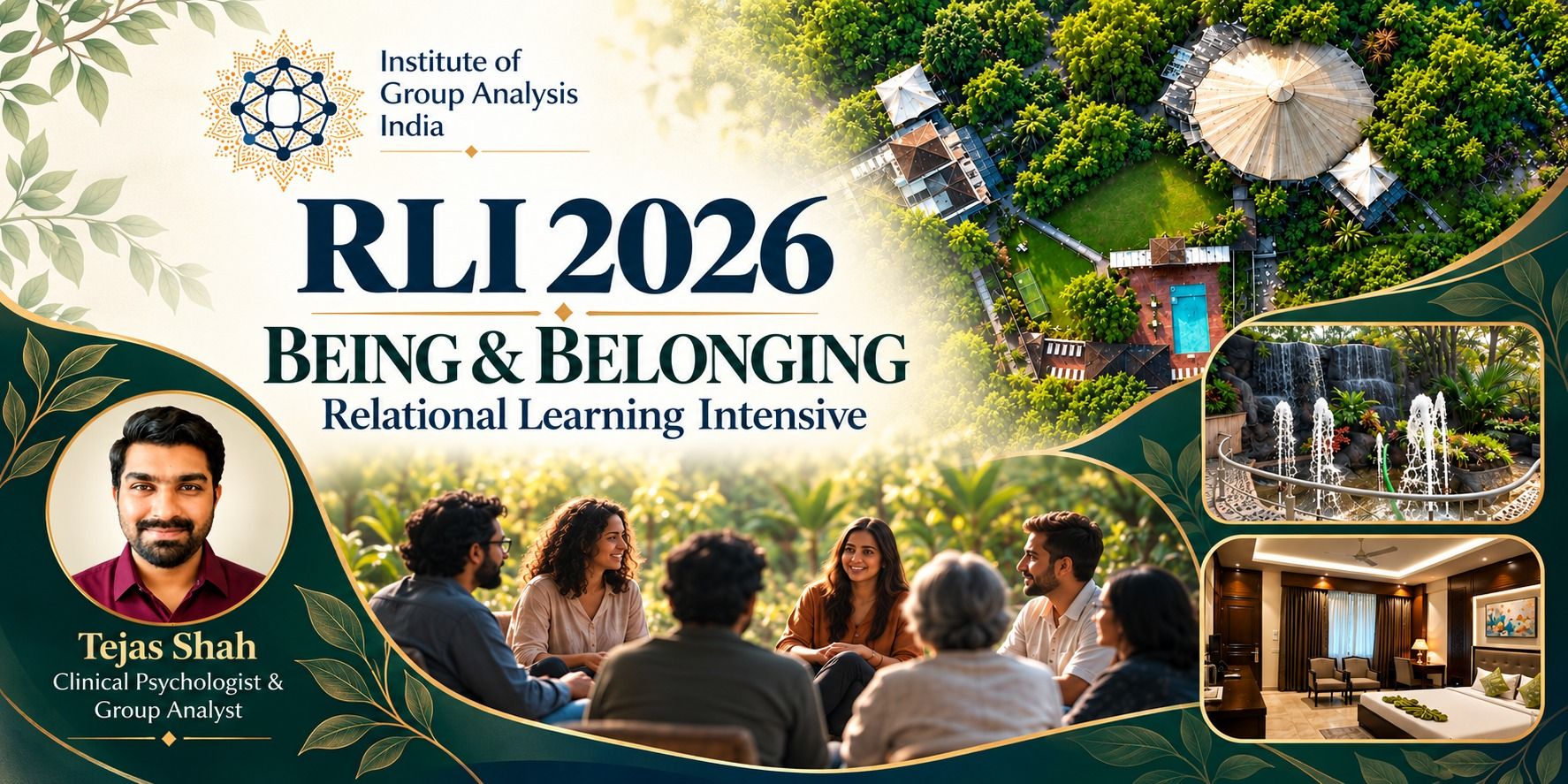
RLI 2026 - BEING & BELONGING
Relational Learning Intensive
Self, Relationships & Group Life
Relational Learning Intensive, or RLI, is a two-day residential experiential programme exploring self, emotions, attachment, relationships and group life.
Over the residential weekend, a small community comes together to explore what happens when we meet other people, form relationships, find our place in groups, experience closeness and difference, and become more aware of ourselves through others.
At the centre of the 2026 theme, Being & Belonging, is a fundamental human question:
How can we belong without losing ourselves - and be ourselves without losing belonging?
RLI is not primarily about learning psychological ideas through lectures. It is about learning through participation, experience and reflection.
Participants move between small experiential groups, whole community groups, shared residential life and periods of unstructured time. What happens between people becomes part of what can be noticed, reflected upon and understood.
THE THEME - BEING & BELONGING
Human beings need both connection and individuality.
We want to belong, to be recognised, understood and accepted. At the same time, we want autonomy, privacy, freedom and the ability to remain ourselves.
Too much pressure to belong can lead to conformity and loss of individuality.
Too much separateness can lead to isolation and disconnection.
During the weekend, participants may find themselves becoming curious about questions such as:
How do I find my place among other people?
What helps me feel that I belong?
What makes me withdraw or feel excluded?
What happens to my emotions when I am with others?
When do I speak freely, and when do I become silent?
How do I respond to closeness and intimacy?
What happens when somebody is different from me?
How do I respond to authority, leadership or dependency?
What roles do I repeatedly find myself occupying?
What happens when conflict or disagreement appears?
How much of myself can I bring into a relationship while remaining connected to others?
There are no predetermined answers.
The invitation is to become more curious about what happens within us, between us and within the group as a whole.
WHAT IS A RELATIONAL LEARNING INTENSIVE?
RLI is a residential experiential learning programme in which participants explore themselves, their emotions, relationships and group life through participation, reflection and shared experience.
Rather than discussing relationships only intellectually, participants have an opportunity to notice relational patterns while they are actually occurring.
A group can make visible aspects of ourselves that may otherwise be difficult to recognise.
We may begin to notice how we seek recognition, how we respond when another person takes up space, how quickly we move towards or away from people, how we manage uncertainty and vulnerability, how we respond when we feel overlooked, and what roles we tend to take up with others.
The purpose is not to perform well in a group.
It is to develop greater emotional awareness, psychological mindedness and reflective capacity.
THE EXPERIENCE
Throughout the weekend, each participant belongs to one small experiential group and also participates in the whole RLI community.
Small Experiential Groups
The small group provides a more intimate relational setting.
There is no predetermined topic that participants must discuss. Attention can move between what is being spoken about and what may be happening emotionally and relationally between members.
Participants may become more aware of recurring interpersonal patterns, closeness and distance, emotional responses, silence and participation, expectations of others, conflict, vulnerability, dependency, autonomy and the roles they take up.
Community Groups
All participants meet together in the larger community group.
The larger setting can make different aspects of group life more visible, including belonging, exclusion, authority, leadership, subgroup formation, visibility, difference, participation, voice and silence.
The community group offers an opportunity for the residential community to think about its own experience as it develops.
Residential Community Life
Learning is not limited to formal sessions.
Meals, breaks, informal conversations, walking, resting, choosing whom to spend time with, being alone, returning to the group after an emotionally significant encounter, or simply noticing the atmosphere of the community may all contribute to the experience.
The weekend moves between:
Self - Relationship - Small Group - Community
PSYCHOLOGICAL AND CLINICAL FOUNDATIONS
RLI draws upon several complementary traditions of psychological understanding.
Group Analysis
Group Analysis understands people within the networks of relationships, groups, cultures and communities in which they develop and live.
A group is more than a collection of individuals.
Over time, a shared relational field develops in which patterns of communication, roles, alliances, belonging, difference and authority can become visible.
Participants may recognise aspects of themselves through other people, resonate with another person's experience, or discover how something experienced as intensely personal may also be connected with the wider group.
Group Analysis encourages us to think across:
Individual - Relationship - Group - Society
Psychoanalytic and Psychodynamic Thinking
Relationships are influenced not only by conscious intentions but also by expectations, fears, wishes and relational patterns that may operate partly outside our awareness.
Earlier experiences can shape what we expect from present relationships.
Within groups, people may notice patterns involving trust, rejection, criticism, rivalry, shame, withdrawal, excessive accommodation, authority, dependency, disappointment or attempts to control uncertainty.
RLI invites curiosity about what these patterns may mean and what psychological functions they may serve.
Attachment Theory
Attachment theory helps us understand how human beings seek safety, connection and emotional security.
Entering a new group can activate questions such as:
Who is safe?
Will I be noticed?
Can I depend on anyone here?
What happens if I become vulnerable?
Will closeness lead to rejection?
Can I belong without giving up my independence?
Rather than reducing people to attachment labels, RLI explores how needs for connection, autonomy, safety and distance appear within actual relationships and groups.
Relational Thinking
Relationships are co-created.
We influence others while simultaneously being influenced by them.
One person's silence can alter the atmosphere of a group. One person's vulnerability may enable another person to speak. A conflict between two people may express something relevant to the wider community.
RLI therefore encourages movement from asking only:
What is happening with that person?
towards:
What is happening between us?
and sometimes:
What might be happening in the group as a whole?
WHO IS RLI FOR?
RLI is open to adults who are curious about themselves, their emotions, relationships and the groups they are part of.
You do not need to be a psychologist or therapist.
The experience may be particularly meaningful for people interested in self-understanding, emotional awareness, relationships, recurring relational patterns, attachment, intimacy, belonging, exclusion, conflict, communication, identity, difference, authority, leadership, group dynamics and personal growth.
RLI is also relevant to professionals whose work depends heavily upon relationships, including psychologists, psychotherapists, counsellors, psychiatrists, mental health professionals, doctors, healthcare professionals, social workers, teachers, educators, coaches, facilitators, leaders, managers, HR professionals, organisational professionals, community professionals, NGO professionals, artists and other people-centred professionals.
No previous knowledge of Group Analysis is required.
FOR CLINICIANS AND HELPING PROFESSIONALS
For clinicians and helping professionals, RLI offers an opportunity to develop something central to therapeutic and relational work:
The capacity to use oneself reflectively within relationships.
Participants may become more aware of what other people evoke emotionally in them, how they respond to dependency or vulnerability, when anxiety alters communication, how attachment processes emerge, how authority is experienced, how relational patterns repeat themselves, and how their own responses influence an interaction.
The emphasis is experiential rather than diagnostic.
Psychological ideas are used as ways of thinking about experience, not as labels for participants.
GROUP ANALYSIS PATHWAY
For participants interested in professional development, RLI also serves as an introductory experiential programme in Group Analysis and a prerequisite towards further Group Analysis training with the Institute of Group Analysis India.
It provides an opportunity to encounter Group Analytic ideas not only theoretically, but through direct experience of small group and community processes.
THE RESIDENTIAL RETREAT EXPERIENCE
RLI takes place within a luxury wellness resort surrounded by greenery and restorative spaces.
The environment has been chosen to complement the emotional and relational work of the weekend.
Between formal sessions, participants have substantial unstructured time to rest, walk, enjoy the natural surroundings, spend time alone, connect informally with other participants, use common spaces, relax, reflect and allow the experience of the groups to settle.
The intention is not to fill every hour with activity.
The spaces between formal sessions are part of the rhythm of the residential.
The weekend brings together:
Experience - Reflection - Relationship - Rest
PROGRAMME FORMAT
Each participant attends:
2 Small Experiential Group Sessions
4 Whole Community Group Sessions
All formal group sessions are 90 minutes.
This provides approximately 9 hours of structured experiential group work across the weekend, alongside shared residential life and substantial unstructured time.
Participants are expected to attend the complete residential programme.
GROUP SIZE
Maximum 15 participants
RLI is intentionally kept small.
The limited size allows sufficient intimacy for small group work while also creating a meaningful whole community experience.
FACILITATOR
Tejas Shah
Clinical Psychologist & Group Analyst
The programme is offered by the Institute of Group Analysis India and facilitated within a Group Analytic, relational, psychodynamic and attachment-informed framework.
ABOUT THE INSTITUTE OF GROUP ANALYSIS INDIA
The Institute of Group Analysis India works towards developing Group Analysis within the Indian context through experiential programmes, education, training and dialogue.
Its work is based on the understanding that people cannot be fully understood in isolation from their relationships, groups and wider social worlds.
RLI is part of this endeavour - an opportunity to encounter the psychology of relationships and groups from within the experience itself.
For more information: www.groupanalysis.in


