

About The Event
Sangitanjaly Foundation (a non-profit trust and NGO) is one of the established cultural organisations in India that promotes Indian art and dance forms, including folk, light music, fusion, Sufi and other forms.
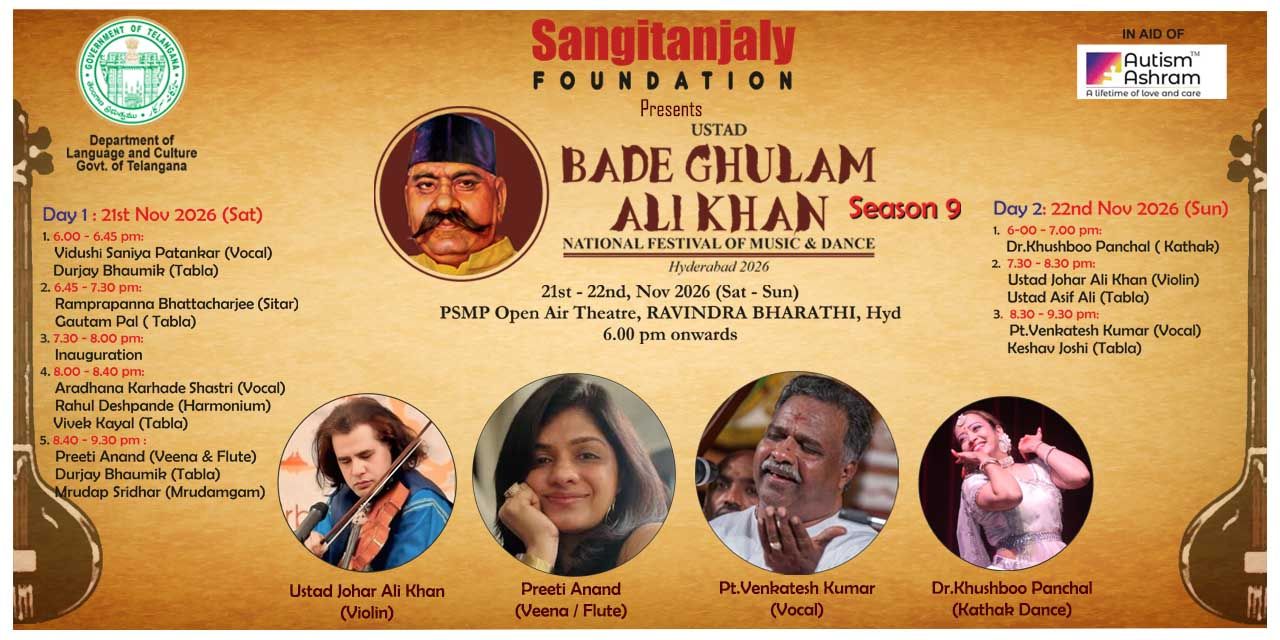
Sangitanjaly Foundation is organising the 9th Season of the Ustad Bade Ghulam Ali Khan National Festival of Music & Dance on 21–22 November 2026 in Hyderabad. It is a great honour for the Foundation to offer its Shradhanjali and remember Ustad Bade Ghulam Ali Khan Saheb, who spent his last days in Hyderabad. Ustadji's Mazhar is located in Hyderabad, at Dara Mir Momin in Hari Bowli, near Charminar. This festival is being organised in his honour as a mark of reverence to this legendary musician.
Ustad Bade Ghulam Ali Khan was a Hindustani classical vocalist from the Patiala Gharana. He was born in Kasur, a small town near Lahore, Pakistan. In 1957, with the help of Bombay Chief Minister Morarji Desai, he acquired Indian citizenship and moved to a bungalow at Malabar Hill in Mumbai. He lived at various times in Lahore, Bombay, Calcutta and Hyderabad.
At the age of five, Bade Ghulam Ali Khan began learning vocal music from his paternal uncle, Kale Khan, and later from his father, Ali Baksh Khan. He amalgamated the best of three traditions into his own Patiala-Kasur style: the Behram Khani elements of Dhrupad, the gyrations of Jaipur and the behlavas (embellishments) of Gwalior. Many of his raga expositions were brief, contrary to convention. While he agreed that the beauty of classical music lay in leisurely improvisation, he believed that audiences would not appreciate long alaps. He felt that he had to sing for the masses and adapt his music to what the audience wanted.
He excelled at more light-hearted ragas such as Adana, Bhupali, Hameer, Jaijaiwanti and Jaunpuri. He was persuaded by film producer K. Asif to sing two songs based on the ragas Sohni and Rageshree for the 1960 film Mughal-e-Azam, with music directed by Naushad. He was awarded the Sangeet Natak Akademi Award and, in 1962, the Padma Bhushan. He died at Basheerbagh Palace in Hyderabad on 23 April 1968 after a prolonged illness, which had left him partially paralysed during the last few years of his life. He continued to sing and perform in public with the support of Munawar Ali Khan until his death.
Ustadji came to Hyderabad at the invitation of Nawab Moin-ud-Dowla Bahadur, who heard him sing on the radio and sent someone to Pakistan to bring him to Hyderabad. Ustad Bade Ghulam Ali Khan then stayed in Hyderabad for a very long time.
It was his wish to be buried here. His grave (Mazhar) is located at Daira Mir Momin in Hari Bowli, Charminar, Hyderabad.
Why This Festival in Hyderabad?
Ustad Bade Ghulam Ali Khan had a special liking for Hyderabadi Tehzeeb and always enjoyed his stay in the city. He is one of the most respected legends for his great contribution to Indian classical music. His name is synonymous with the Patiala Gharana.
His famous thumri composition, ‘Ka Karoon Sajni Aaye Na Balam’, based on Raag Sindh Bhairavi, is an all-time favourite among Hindustani classical singers. His thumri ‘Yaad Piya Ki Aaye’, based on Raag Bhinna Shadaj, and bhajan ‘Hariom Tatsat’, based on Raag Pahadi, are also among the most popular compositions of all time.
His music transcended borders and connected with music lovers across communities.
Ustad Bade Ghulam Ali Khan spent his last days in Hyderabad, and his Mazhar is also located near Charminar. It is therefore fitting that a festival be dedicated to this legendary musician and made an annual celebration, offering respect and gratitude to this great soul.
Community Engagement and Development Initiative
India is considered a multicultural, multi-ethnic and multilingual subcontinent.
The very essence of unity lies in its diversity. Language, art, culture, literature and other such elements are the noble threads that bind communities together. They connect people across the length and breadth of the country.
It has been proven time and again that community engagement initiatives through language, art, culture and literature connect very well with people in India.


