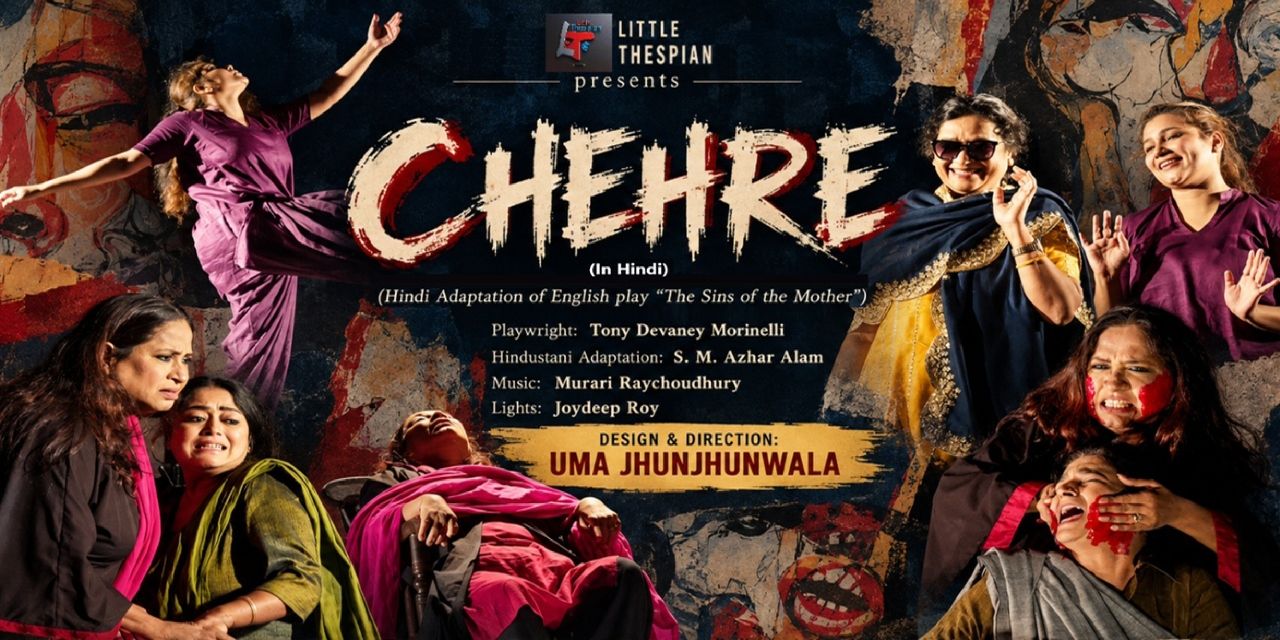


About The Event
Chehre is a one-act psychological family drama that examines the destructive legacy of alcoholism, emotional abuse, and generational trauma through the lives of three generations of women in a Muslim family. Set within the confines of the family home, the play unfolds through a series of emotionally charged confrontations and memories that gradually expose the origins of a cycle of pain that has shaped every member of the family.
At the center of the play is Amina, an aging alcoholic whose bitterness, emotional volatility, and controlling nature have made life unbearable for her two unmarried daughters, Ishrat and Razia. Having devoted years to caring for their mother, the sisters have sacrificed their own dreams, relationships, and independence. Ishrat, the more responsible and delusional of the two, has spent much of her life suppressing her emotions in order to maintain the household, while Razia is more practical and struggles more openly with resentment, frustration, and the desire to escape the suffocating environment in which they have lived. Their relationship is marked by affection as well as conflict, revealing the different ways in which trauma manifests in individuals raised under the same circumstances.
As the drama progresses, the arrival and involvement of Nasima (Amina’s sister), provide a crucial perspective on the family’s past. Through her recollections and conversations, the audience learns that Amina was not born cruel but was herself shaped by a childhood dominated by fear, neglect, and emotional deprivation. These memories introduce the influence of the sisters’ mother, the family matriarch and grandmother (Amma) to Ishrat and Razia, whose rigid expectations, harsh treatment, and inability to express love created deep emotional wounds within her daughters. Although the grandmother does not occupy the central action of the play in the present, her presence is felt throughout the narrative, symbolizing the origin of the family’s inherited suffering. Nasima serves as both a witness and a contrast to Amina, demonstrating how two individuals exposed to the same painful upbringing can respond differently to their shared experiences.
The play gradually reveals that the family’s tragedy lies not only in Amina’s alcoholism but also in the emotional legacy passed from one generation to the next. Amina becomes both a victim of her mother’s failures and a perpetrator of similar abuse toward her own daughters. Ishrat and Razia, despite recognizing the damage inflicted upon them, find themselves struggling with the same feelings of anger, guilt, dependence, and emotional repression that have defined the women before them. Their attempts to confront Amina become, in many ways, an attempt to confront the unresolved history of their family.
Rather than presenting clear heroes and villains, Chehre portrays each character with compassion and complexity, illustrating how trauma can distort love, communication, and family relationships. The title reflects the central idea that the consequences of one generation’s actions continue to shape the lives of the next, unless those patterns are consciously confronted and broken. Through its intimate setting, psychologically realistic dialogue, and emotionally layered characters, the play explores themes of motherhood, alcoholism, emotional abuse, identity, sacrifice, forgiveness, accountability, memory, and the enduring impact of generational trauma. Ultimately, it leaves the audience questioning whether inherited pain must inevitably define the future, or whether acknowledging the truth of the past can become the first step toward healing.


