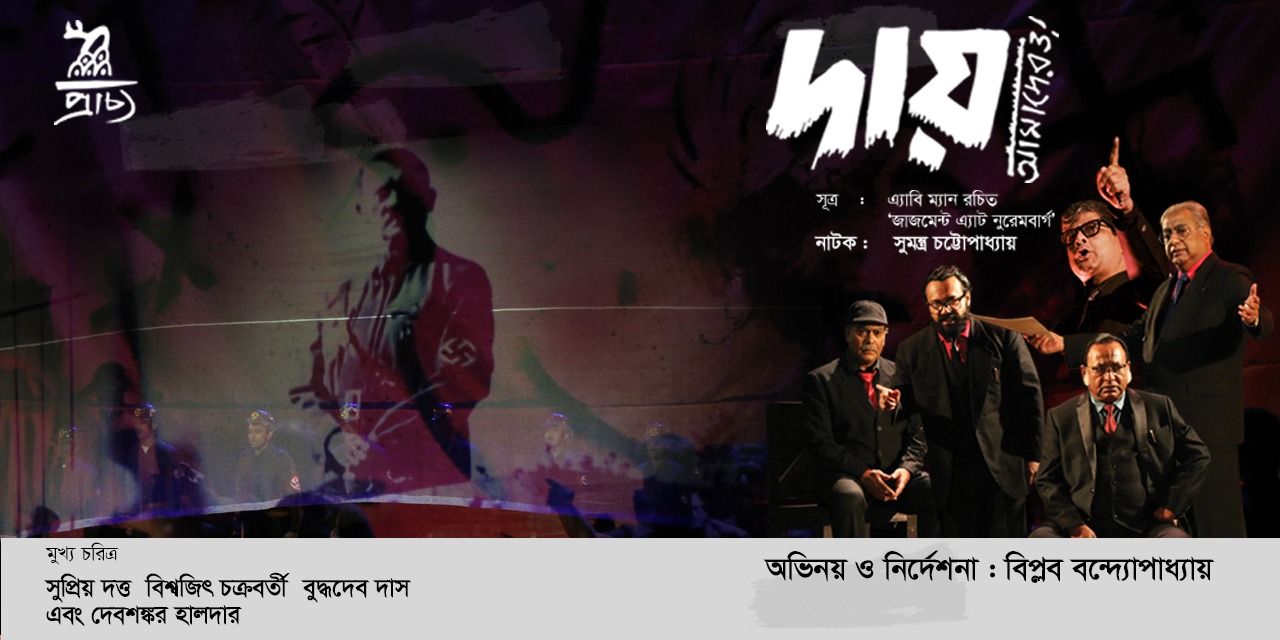


About The Event
The play, based on the historic event of the trial of judges of the Nazi era, conducted by the US Military Court, can be said to belong to the genre of historical fiction. The play uses the dialogue list of the screenplay written by Abby Mann only as a take-off point.
World War II is over, Hitler is dead, and Germany has surrendered. So has their ally Japan, after the brutal bombing of Hiroshima (6th August 1945) and Nagasaki (9th August 1945). Chancellor for a day, Goebbels has committed suicide along with his entire family. The International Tribunal has sat in judgement of the Nazi leaders and has sentenced eleven of them. It was followed by the trial of the doctors, and then the trial of the judges. It is this trial of the judges that forms the content of this play. Three leading judges, Ernst Jenning, Hoffstetter, and Emil Hann, are being tried. The foremost of them is, of course, Ernst Jenning, who is also a figure in the academic world of the study of law around the globe. The trial is taking place in the historic courtroom in the city of Nuremberg, from which all the signature Nazi laws were formulated and declared.
Jenning is being represented by advocate Rolf, who is a sort of self-appointed counsel. He comes to the prison to meet Ernst, who is not exactly interested in his own defence. The trial begins, with the Allied forces represented by Lawson. An important witness, who was once part of the German judiciary, testifies how the judicial system was reduced to a mockery after Hitler's rise. Next comes the topic of forced sterilisation practised by the Nazis against those they considered politically dangerous. Rudolf Peterson, a victim of forced sterilisation, is produced before the court. Ernst Jenning says he is unwell and wants to be excused from the court, visibly upset.
Lawson, who was part of the US army, shows a short film with the court's permission that depicts the horrors of various concentration camps. Rolf, defending Ernst Jenning, calls him a patriot, as he had not escaped from his duty. A very famous case of those days, the Feldenstein case, is sort of reopened. In this case, based on the notorious anti-race-defilement law, an aged Jew, Mr. Feldenstein, was sentenced to death for having an illicit relationship with a Christian young girl, Irene Hoffman. She is again summoned to court and subjected to obnoxious questioning by Rolf. It becomes clear that the charges against Feldenstein were baseless.
Judge Haywood meets Ernst Jenning in prison, somewhat outside the precinct of law. They have a very poignant conversation where Ernst accuses Haywood of the excesses of carpet bombing in Dresden and the dropping of the atom bomb on Japan. Haywood is a member of the committee that sanctioned the dropping of the atom bomb. Ernst Jenning says that one day the world will question why the US will not be subjected to trial on the same grounds on which the US and Allied forces are putting fallen Nazis on trial.
Ernst Jenning admits that he was the judge in the case, and that he knowingly passed a wrong sentence, as he was asked to do so by the State. Ernst Jenning explains what Hitler meant to the German people and the real form of Nazi euphoria, a euphoria that had made people callous and insensitive. Rolf argues that if Hitler is to be blamed, the whole world should be blamed alongside him, because the Vatican had hailed Hitler, so had Winston Churchill (PM of the UK), Stalin had entered into a pact with him, India's freedom fighter Subhas Bose had sought his help, and US businessmen had sold him arms. The court sentences all three under trial to life imprisonment.
News comes that Ernst Jenning is dead. He had stopped taking the medicines needed for his heart ailment, and has left a letter for Judge Haywood. The play ends with the sequence of Haywood reading out the letter, with the surrealistic presence of Ernst Jenning. Jenning has accused Haywood of presiding over a trial that was not neutral, where the verdict was predetermined in view of the post-war days. In the letter, Ernst has quoted a few deeply poignant lines from Tagore's "Crisis in Civilisation."


