

About The Event
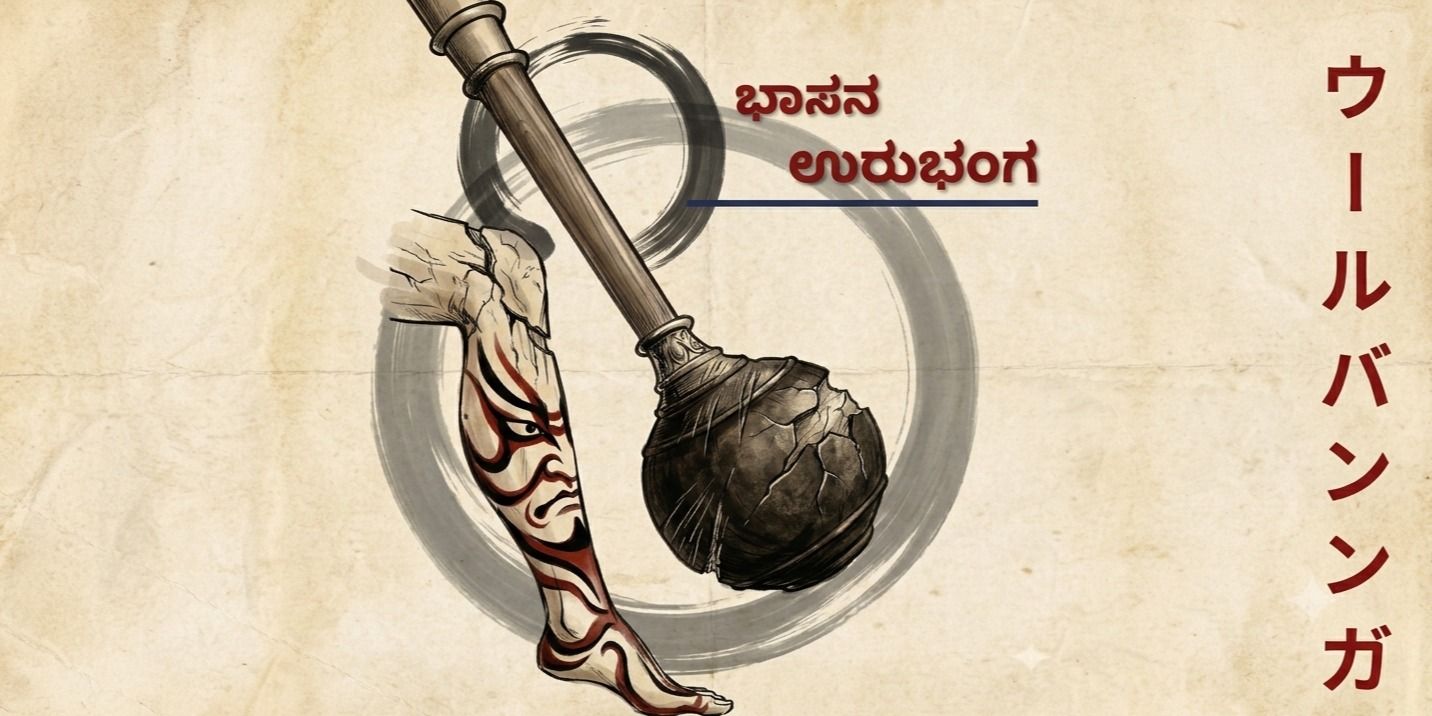
Urubhanga, written by the great Sanskrit poet Bhasa, is a unique one-act tragedy. Unlike other Mahabharata versions where Duryodhana is shown as a villain, Bhasa shows him as a tragic hero.
The play depicts the tragic final duel of the Kurukshetra War. After losing all his brothers, army and friends, Duryodhana is alone. Bhima and Duryodhana meet for the final mace fight (Gadayuddha). During the fight, Bhima breaks the rule of war and hits Duryodhana on his thighs (Uru Bhanga), which is forbidden. Duryodhana falls down mortally wounded.
The second half of the play is very emotional. The defeated king, who is now noble and humane, transforms into a dying hero. His parents Dhritarashtra and Gandhari, his wife Bhanumati, and his son Durjaya come to see him. He bids a heart-touching farewell to his family and dies with dignity, forgiving everyone.
*Adapted into Kabuki Form:*
We are presenting this ancient Indian tragedy in the classical Japanese Kabuki style. The story is told entirely through stylized physical movement instead of natural dialogue.
*1. For the Duel:* We use Kabuki's _Tachimawari_ - rhythmic and dance-like fight choreography. The maces are used with slow, circular and highly stylized movements with the sound of wooden clappers (Ki).
*2. For the Fatal Blow:* When Bhima breaks Duryodhana's thighs, we show it through a dramatic collapse. The actor does a slow-motion _Mie_ pose - eyes wide, body frozen - and then collapses to the center stage. The breaking of thighs is not shown realistically but symbolically.
*3. For Paralysis and Agony:* After the fall, the lower body of the actor remains completely still to show paralysis. All the emotions - physical pain, emotional agony, and final dignity - are conveyed only through intense upper-body postures, sharp recoils of the neck, trembling hands, and powerful facial expressions with Kumadori make-up. White and red make-up will be used to show his nobility and pain.
In the end, Duryodhana dies not as a defeated villain, but as a great, dignified Kshatriya, which is the core idea of both Bhasa and Kabuki theatre.


