

About The Event
Custodian Theatre Group Presents Sapno Mein Sahi.
Bombay does not sleep. It hums and churns, swallows people whole, and keeps
moving, indifferent as a river to the stones it carries. In this city of perpetual motion, two kinds of madness find each other. Sapno Mein Sahi is a romantic tragedy set against the unrelenting pulse of Bombay, where the city itself becomes a character, loud, merciless, and strangely tender to those it has broken.
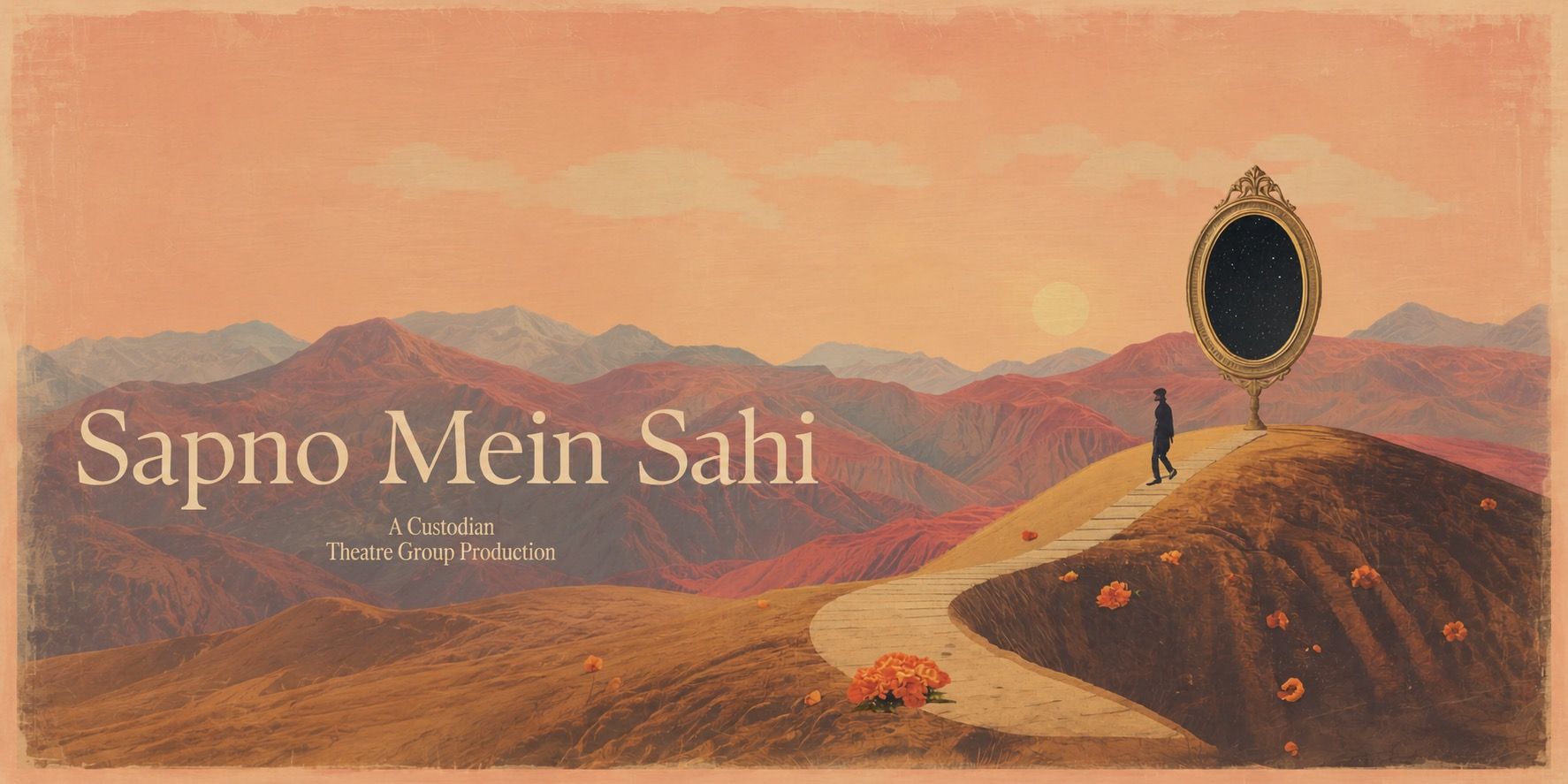
Shashi lives on the streets, a painter when the mood descends on him like light through clouds. He does not chase purpose or position. He chases his dreams, literally. Each night pulls him under into a world vivid and cryptic, and each morning he wakes with the urgency of a man who has received a message he has not yet learned to read. The world has no patience for him. It calls him nonsensical, moves around him the way pedestrians move around a stone on the footpath, without anger, without acknowledgment. He is invisible. And yet, Shashi watches everything. Mehreen arrives in Bombay with a suitcase and a job: she is to write obituaries for a local newspaper, to compose, each day, the final sentence of someone elses life. The irony is not lost on her. She is a young woman fluent in other peoples endings while her own story accumulates pressure, clause upon clause, like a legal document she never agreed to sign. Responsibility is the only language she has ever been taught. Duty, her mother tongue. They should not make sense to each other. And for a while, they do not.
But Bombay, in its chaos, is also an arranger of impossible coincidences. Shashi and Mehreen meet and in meeting, something stirs. Not romance, at first. Recognition. The eerie, unsettling feeling of having found the missing piece of something you had forgotten you were building. His dreams begin to reflect her life. Her words begin to breathe with his imagery. Between the two of them, a strange grammar emerges, one that neither their worlds nor their languages had prepared them for. Sapno Mein Sahi does not ask you to believe in fate. It asks something harder: that you look at your own madness, the way you too have been imprisoned by what you cannot stop dreaming, or cannot stop doing, or cannot stop being and that you sit with it, gently, without turning away. Because the chains are real. But so, sometimes, is the person who sees them on you before you do.


